|
St Francis |
|

REFRIGERATION
| Refrigerator Upgrade | Freezer Upgrade |
| Laser Temperature Gun | |
Last Updated: 03/26/2023
12 Volt Refrigeration in General
To see the evolution of the refrigeration system on our last boat, and a bunch of info on re-insulating old boxes and maintaining older holding plate systems, see the Refrigeration page for our CSY.
After doing a some major upgrades to the "stock" refrigeration system on our CSY, we eventually ripped out the old Crosby holding plate system and installed a Frigoboat system in early 2010. We are glad we did. The small BD50 compressors are very efficient and more conducive to running with solar than the large holding plate system.
Two great references on marine refrigeration are Nigel Calder's book on Refrigeration, and a newer better Nigel Calder book that incorporates his earlier book on refrigeration...the latest version of his Mechanical and Electrical Manual. The Mechanical and Electrical Manual has more up-to-date information on the newer refrigeration systems, and should also be reviewed for a more complete picture of the current state of the art.
Upgrading the Refrigeration System on our St. Francis Catamaran
The standard St. Francis 44 comes with a large top-loading refrigeration/freezer box built into the cabinetry in the main cabin, and a small off-the-shelf front-loading refrigerator built into the cabinetry in the galley.
The top-loading system is a Danfoss BD35-based evaporator plate style 12 volt system, built as a drop-in by Minus 40 in South Africa. Ours is encased in lovely cabinetry and has a custom power unit that is designed to run off either 12v or 220v (this is not the stock Danfoss power unit).
This box can be configured as a refrigerator, freezer, or sort of a combo unit just by changing the (single) thermostat. The box is fairly well insulated and runs fairly efficiently as a freezer even in hot weather. Though, it is air-cooled, so the heat from the compressor gets blown into the main cabin.
When we first cruised with our new-to-us SF 44, we had a lot of arguments over space in the tiny refrigerator. We used the top (warmest) area of the big freezer as overflow refrigeration. But that area was not useable for storage of things like fruit and veggies that get damaged by being too cold.
So, one of the first major projects on our SF 44 was to upgrade the refrigeration situation. We ended up removing the Waeco Coolmatic CR-50 completely and selling it second-hand to another cruiser.

Our original tiny fridge
The only area near the galley able to take a large refrigerator box was the forward half of the aft bunk area in the port hull (right next to the galley). So we constructed a front loading 8 cu ft refrigerator with 4" of extruded PVC foam (blue board insulation) providing R-26 insulation value all around. It has two doors with the outside box made of .5" marine plywood fiberglass sealed on both sides and the inner box and shelves made of .5" expanded PVC white sheet.
The refrigeration unit is a Frigoboat Keel Cooler system with a BD-50 compressor and F200 evaporator plate. These were chosen so that we could normally run the unit at its slowest speed which minimizes its daily amp hour use.

New Box Under Construction
The new box is big enough that it doesn't fit through the doorways, so it had to be designed and built such that it could be assembled onboard.
We sized the various shelf spacing to make sure we had at least one space that could accommodate tall things like juice cartons and wine bottles, but trying to maximize storage room.
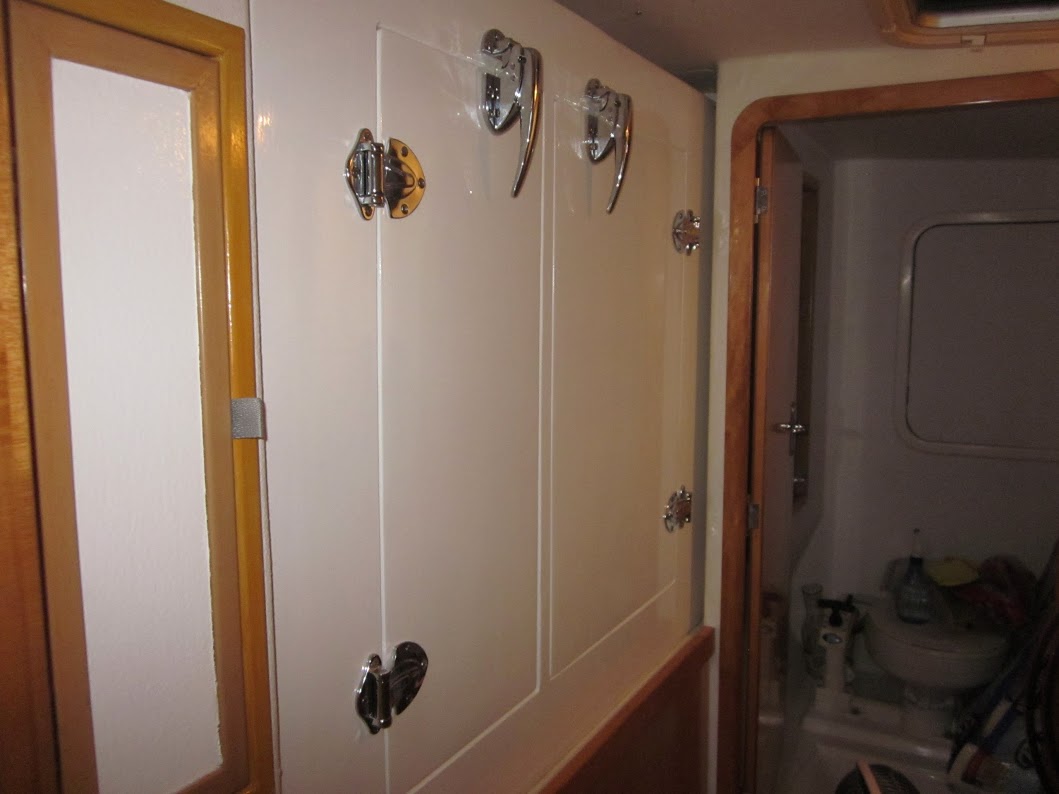
Our New Refer Installed
Added storage: With the front half of the port aft bunk holding the new refrigerator, the aft half was available for a 'big box' pantry area. It is 36" wide by 30" deep and full height of the bunk area (without the mattress of course). There are two shelves spaced to take large dry goods items.
And the space in the galley where the Waeco was, was also turned into shelving. So this project hugely increased our refrigeration space as well as the dry storage space.
Inboard of the refrigerator and pantry, accessible from a new cockpit hatch under the port cockpit seat, is an area the full length and height of the bunk and about 22" deep that holds long items like bolts of Sunbrella, floating noodles, paddles and other long items.
This is all in addition to the original pantry located just aft and outboard of the cabin door at the aft end of the galley.
The unit is a perfect size for us and provides significant convenience over a top loading unit with about the same energy use.
More info and pictures:
-
Full pictures of the system under construction and after completion are in our Photo Album.
The factory-installed Minus 40 freezer is top loading and with about 4 cubic ft of interior volume. This is certainly adequate in capacity. But it wastes many amps because the Danfoss BD35 compressor is undersized and air cooled and because the insulation is half what it should be. It uses nearly 80 ahrs a day running at full compressor speed to keep up.
So when we had the chance to purchase a lightly-used Frigoboat Keel Cooler system with a Danfoss BD50 compressor for less than $500, we did. We called Minus 40 to find out if the evaporator could be removed and replaced—it cannot. So we used a local refrigeration mechanic with proper brazing tools to marry the Minus 40 evaporator coils with the Frigoboat compressor unit.
Because I was distrustful of the cleanliness of the brazing work, I added a new filter drier, flushed the entire system with refrigerant, took a 12 hour vacuum on it and then refilled it with R134a refrigerant. It now runs perfectly with the new larger compressor and much more efficient keel cooler condenser. The daily amphr use is about 59ahrs.
The only unanticipated problem we encountered with this hybrid system is that the Minus 40 has much larger evaporator coils than the evaporator that normally comes with the BD50. We found that, in warm tropical waters, the keel cooler could not keep up with cooling the bigger system. We ended up adding an air cooler to the system to provide extra cooling in warmer conditions. We can switch off the air cooler when it is not needed.
To provide better access to the compressor, we added a door into the compressor area from the footwell of the nav station. This allows us to easily disconnect the 220v power cord and the keel cooler line if we need to lift the freezer box out of its outer shell.
 One tool we use all the time for checking interior temps on the refrigerator and
freezer is a
Raytek Mini Temp Non-Contact Digital Thermometer Gun. With this
little hand-held device, you 'shoot' any surface you want to take the
temperature of, and it immediately indicates the surface temp of whatever
you are aiming at. This is perfect for checking that your thermostat
settings on your fridge or freezer are set properly.
One tool we use all the time for checking interior temps on the refrigerator and
freezer is a
Raytek Mini Temp Non-Contact Digital Thermometer Gun. With this
little hand-held device, you 'shoot' any surface you want to take the
temperature of, and it immediately indicates the surface temp of whatever
you are aiming at. This is perfect for checking that your thermostat
settings on your fridge or freezer are set properly.
It is also useful for checking the OUTSIDE of your box for cold leaks.
Copyright 2022
WebDesignsInternational